 en
 Български


SubTotal: 00.00 BGN
This site uses cookies to help give you the best possible user experience. By continuing to browse this site you give consent for cookies to be used!
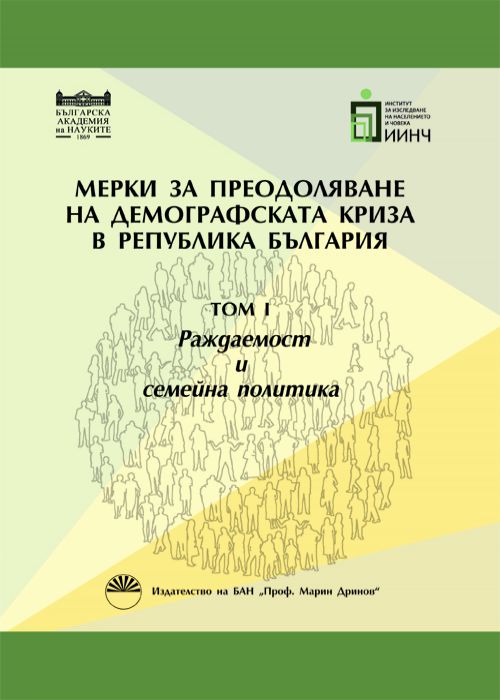
Measures to overcome the demographic crisis, Volume I
Birth rate and family policy
Stanislava Moraliiska-Nikolova, Georgi Shopov, Tatyana Koceva, Elica Dimitrova, Iordan Hristoskov, Iolanda Zografova, Korneliya Ilieva, V. Todorova, V. Nedeva-Atanasova, D. Koleva, N. Shabani, M. Malamin-Siriiski
Summary
In the period 2016-2018, the Institute for Population and Human Studies at the Bulgarian Academy of Sciences was the lead executor of a large-scale national project "Measures to Overcome the Demographic Crisis", assigned to the Bulgarian Academy of Sciences by the Council of Ministers No. 347 of 8.12.2016. This collection unites the efforts of a team of specialists from the "Fertility and Family Policy" working group, who, in cooperation with experts from the non-governmental sector, aimed to prepare detailed analyses of trends in fertility and the state of family policy in the Republic of Bulgaria, as well as to propose a package of measures to improve policies in support of families and children. The "Fertility and Family Policies" working group shares the vision that family policy in the country should be aimed at improving the quality of life and access to basic services for families with children, such as healthcare, education, the social sphere and support services in case of conflicts and difficulties in the family. Emphasis only on pronatalist policies is not the most effective way to find resources to increase the birth rate.
The collection presents the authors' analyses of birth rate trends in the period after 1990, analyses of the regulatory framework related to families and children in the Republic of Bulgaria, analysis of family policy, as well as national strategies in various areas that affect the family and children - demography, employment, healthcare, etc.
Good practices in selected European countries are presented in terms of social protection and support systems for families with children. The collection also includes the results of two national representative surveys that reflect the attitudes and opinions of the generations of reproductive age in the country in terms of measures aimed at supporting families and children. Proposals have been prepared for measures that aim to support individuals/couples in their reproductive decisions. Detailed opinions and financial estimates have been developed for some of these measures. The package of measures was discussed at Expert Councils, as well as presented at a workshop at the Ministry of Labor and Social Policy.
Improving the well-being and quality of life of families in Bulgaria is a fundamental prerequisite for optimizing demographic reproduction. In addition to the quantitative dimensions of reproduction, it is also important to invest in the quality of human capital. Investments in healthcare, education, social services for families and children have long-term returns and are key to the human capital that the country will have in the future.
About The Authors
- • Stanislava Moraliiska-Nikolova
 Assistant Stanislava Emilova Moraliyska - Nikolova graduated Natural Science and Mathematics School "Prof. Emmanuel Ivanov ", Kyustendil. She has MSc in Informatics received by the Southwestern University "Neophyte Rilski", Blagoevgrad. From 2006 she worked as a senior expert at the Center for Population Studies, BAS, and since 2009 she has been an assistant in "Reproductive processes and structures of the population" at the Institute for Population Studies and Human at the Academy of Sciences and a PhD student in the course "Statistics and Demography". She has participated in national and international projects. Her research interests and publications are in the field of modeling of demographic processes, policies on population and demographic projections.
- • Georgi Shopov
- Georgi Shopov, Ph.D., works at the Institute for Economic Research of the Bulgarian Academy of Sciences, Macroeconomics Section. He is the author of articles, studies and books on the problems of social assistance, social security and regional social development. He has participated in over 60 research projects funded by international and national programs and institutions. He has repeatedly been a consultant to the World Bank, the United Nations Development Program, the Organization for Economic Co-operation and Development, the International Labor Organization, and the United States Agency for International Development. In the first half of the 1990s, he worked as an adviser in the Council of Ministers, Deputy Minister and Secretary General in the Ministry of Labor and Social Policy.
- • Tatyana Koceva
- • Elica Dimitrova
- • Iordan Hristoskov
- Yordan Hristoskov is a professor in the Macroeconomics section of the Institute for Economic Research at the Bulgarian Academy of Sciences and vice-rector of the Higher School of Insurance and Finance - Sofia. He is the author of monographs, scientific studies, articles and reports on social policy and social security, labor market, infrastructure and regional development, published in Bulgaria and abroad. He held the positions of Deputy Minister and Minister of Labor and Social Welfare (1991–1995), Advisor to the President of the Republic of Bulgaria on Social Affairs (1995–1997) and Governor of the National Social Security Institute (2000–2009). He is a member of the Bureau of the International Social Security Organization, consultant and expert on a large number of projects and events of the World Bank, the Organization for Economic Cooperation and Development, the United Nations Development Program, the European Commission and others.
- • Iolanda Zografova
- • Korneliya Ilieva
- • V. Todorova
- • V. Nedeva-Atanasova
- • D. Koleva
- • N. Shabani
- • M. Malamin-Siriiski
Specifications
Recently Viewed е-Books


