 en
 Български


SubTotal: 00.00 BGN
This site uses cookies to help give you the best possible user experience. By continuing to browse this site you give consent for cookies to be used!
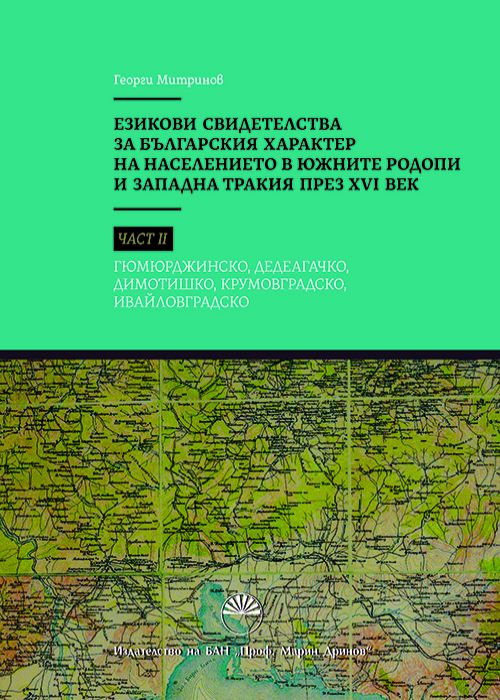
LANGUAGE EVIDENCE FOR THE BULGARIAN NATURE OF POPULATION IN SOUTHERN RHODOPES AND WESTERN TRACE IN THE XVI CENTURY
PART II. AREAS OF KOMOTINI, ALEXANDRUPOLI, DIDIMOTIHO, KRUMOVGRAD, IVAYLOVGRAD
Dimitar Mitrinov
10 item(s) in stock
Year of Publication: 2021
Cover Type: Soft
Category: Ethnology
Edition: First Edition
Pages: 256
Format: 6x8.4x1.6
Language: Bulgarian
Summary
The study includes anthroponymic and economic data on the Christian population in the eastern part of Western Thrace and in the southeastern Rhodopes. The material is extracted from Ottoman tax registers from the mid-16th century. A comparison is made with anthroponymic material from the Rupchos area in the Central Rhodopes and in the western parts of Western Thrace, according to data from the 16th century, as well as with anthroponymy from the 15th century from different parts of the Bulgarian ethnic territory. This makes it possible to see the specifics of the local anthroponymic system in the regional and Bulgarian languages. Trends in its development are shown. A comparison with data from toponymic and anthroponymic studies of Bulgarian settlements in Western Thrace and the Eastern Rhodopes from more recent times provides a more complete picture of the Bulgarian presence.
ibid. Since, in addition to strictly linguistic (mainly anthroponymic) data, there is information about the material and spiritual culture of the Christian population in Western Thrace and the Southern Rhodopes, the study will be of interest to a wide range of readers and local and foreign researchers of Christian history. The Aegean Sea in the 16th century. It completes the picture of the Bulgarian presence in Western Thrace over the centuries.
Аbout The Author
Specifications
ISBN: 978-619-245-109-7
DOI: n/a
Year of Publication: 2021
Category: Ethnology
Edition: First Edition
Language: Bulgarian
Cover Type: Soft
Pages: 256
Weight (kg): 0.310 kg
Format: 6x8.4x1.6
Width (mm): 60
Height (mm): 84
Тhickness (mm): 16
Recently Viewed Books


