 en
 Български


SubTotal: 00.00 BGN
This site uses cookies to help give you the best possible user experience. By continuing to browse this site you give consent for cookies to be used!
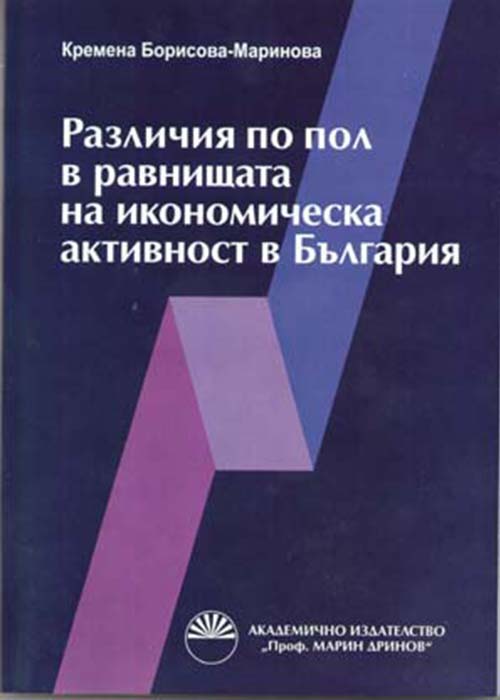
Gender differences in economic activity levels in Bulgaria
Kremena Borisova-Marinova
10 item(s) in stock
Year of Publication: 2011
Cover Type: Soft
Category: Demography
Edition: First Edition
Pages: 212
Format: 6x8.4x1.6
Language: Bulgarian
Summary
This study examines gender differentiation in economic activity and employment processes over the last few decades. It considers the nature and place of the relationship between economic activity and gender in the methodological framework used to study the labor force. It analyzes long-term changes in gender differences in economic activity levels in developed European countries and identifies the characteristics of Eastern European countries, including Bulgaria, in terms of economic activity levels among men and women. The gender differences in economic activity and employment levels in Bulgaria during the period 1985–2001 are examined in terms of five demographic and social characteristics (age, marital status, ethnic group, level of education, and place of residence). A comparative analysis is made of gender differences in economic activity and employment rates in Bulgaria during the period in question. The socio-demographic characteristics selected for the study are ranked according to the strength of their differentiating effect on gender differences in activity and employment rates. The study uses data from the three population censuses in Bulgaria during the period 1985–2001 and from the NSI survey "Employment and Unemployment" for various years within the period 1993–2007.
Аbout The Author
- • Kremena Borisova-Marinova
- Kremena Borisova Marinova worked as an associate professor in the section "Economic and historical demography" of the Institute for Population Studies and Human - BAS. She graduated from the University in 1986 and worked as a Research Fellow in Demography at the Laboratory for Population Research at the research sector of the World Economy under the guidance of Professor Nikola Naumov to 1991: then - at the Institute of Demography - BAS. In 2004 she defended a doctoral thesis in the University and in 2007 she was habilitated at the Center for Population Studies - BAS. Kremena Borisova Marinova is the author of more than 25 scientific publications, including participation in 5 monographs. She has participated in a number of Bulgarian and three international research and development projects. The author`s research interests are in the demographic reproduction of the population and workforce, their modeling and forecasting and in particular: models of population reproduction, changes in demographic and socio-economic structures of the economically active population: factors for developing active population, medium and long-term projections of total and active population: policy on economic activity, demographic aspects of economic activity and more. "
Specifications
ISBN: 978-954-322-406-7
DOI: n/a
Year of Publication: 2011
Category: Demography
Edition: First Edition
Language: Bulgarian
Cover Type: Soft
Pages: 212
Weight (kg): 0.260 kg
Format: 6x8.4x1.6
Width (mm): 60
Height (mm): 84
Тhickness (mm): 16
Recently Viewed Books


